
How to enable USB authentication in facebook.

Facebook has added support for USB key two-factor authentication to improve account security.

Here are the steps to enable USB key authentication on your Facebook account:

Step 1: Go to the Security settings page and expand the Logins Approval section.

Step 2: In the Security Keys section, click the Add Key link and the Add Key button in the dialog that appears.

Step 3: When the prompt appears, plug in your USB key and tap its button when its light starts blinking.
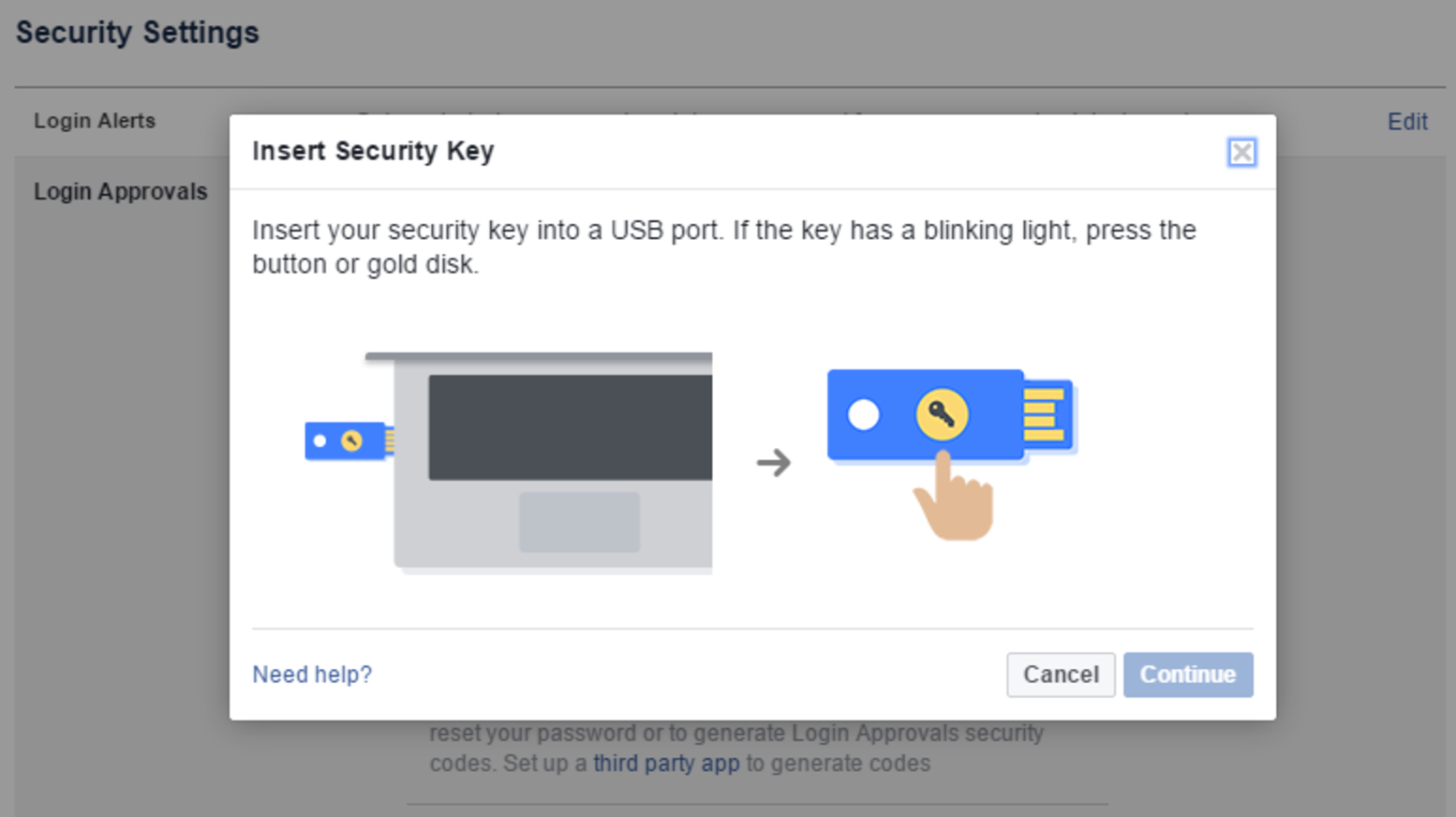
Step 4: Once your key has been added, you’ll be prompted to re-enter your password to confirm the addition and to select a name to represent the physical key.

Step 5: When the process is completed, your newly added key will be visible under the Security Keys section.

If you’re not used to physical authentication keys, here are a few good practices:

Have backups keys: Just like everything else that fits in your pocket, keys can get lost (or possibly stolen). Therefore, you should have backup keys. Facebook’s security settings allow you to add multiple keys and to remove lost or broken ones.Have backup methods: For the moment, only the Facebook desktop website supports USB authentication, and the mobile website supports NFC-based keys such as the YubiKey Neo. Facebook’s mobile apps do not support physical keys yet. Therefore, you should still keep your app or SMS authentication enabled as a backup method.

Facebook’s USB authentication is not mandatory, but it is a welcomed move, as cybercriminals are targeting social media platforms at an accelerating pace. Hopefully, other social media services will follow suit and enable privacy-conscious users to breathe a sigh of relief.

Comments

Popular posts from this blog

So what exactly is cryptography

Nowadays Internet is an important part of Life.  We are using the Internet for sending confidential data also like password,for storing army secrets. But the Internet is insecure medium.we all use internet at a daily basis.  Do you know why? Insecure Medium: Imagine you are sending a data.  In internet world, data are separated as packets and send to the destination.  Do you think the data directly reaching the destination?   If  you think so,you are wrong.  The packets are going through different routers.  Finally, the data is sent to the user.  In this gap, Intruders(i mean attackers) takes advantages. so who are they .the are  I.they  can see what you are sending.  Because your data are simple and easy to readable by anyone. How to secure the data? We can not stop the intruders and their activities.  But we can make our data as Unreadable for Intruders.  For this purpose, the Cryptography is introduce...

Lunix malware havoc

The Krebs DDoS attacks have proven that the IoT landscape is a fertile ground that can breed huge botnets capable of launching massive DDoS assaults. As such, it should be no surprise that malware authors are now focusing their efforts on this sector and putting out new threats in the hopes of building the next Mirai botnet. One of the latest additions to the IoT malware market is a trojan codenamed Linux/NyaDrop, recently reverse engineered by MalwareMustDie, the same researcher who discovered the Mirai malware. MalwareMustDie points out in his research that this binary appeared in May, but was somewhat simplistic and not that common. Things changed after the Krebs DDoS attacks, and a new sample has appeared on the market, with the malware’s author most likely drawn back to the IoT landscape by Mirai’s success. Just like most IoT malware nowadays, NyaDrop’s author relies on brute-forcing Internet-exposed IoT devices using their default credentials. In a conversati...

Remove virus from android

Desktops aren’t the only gadgets that can be affected by a virus. Android devices have a malware problem and it’s growing every day. If you do get a virus, you could perform a factory reset to get rid of it, but that means you’d lose all your data — those photos you shot, the saved games, the text messages, and everything else. Obviously, you want a factory reset to be your last option. So what can you do to remove a virus from Android without a factory reset? Is It Really a Virus? If your phone isn’t functioning the way it should be, there’s a chance you have some malware on it. One wrong tap somewhere and a malicious file might have been downloaded on your phone, which is leeching battery life, Internet resources, or your personal data. But it could be something else. Suppose your Android refuses to boot or crashes every time it starts up. Or maybe you can’t seem to download apps from the Play Store. These are not necessarily caused...