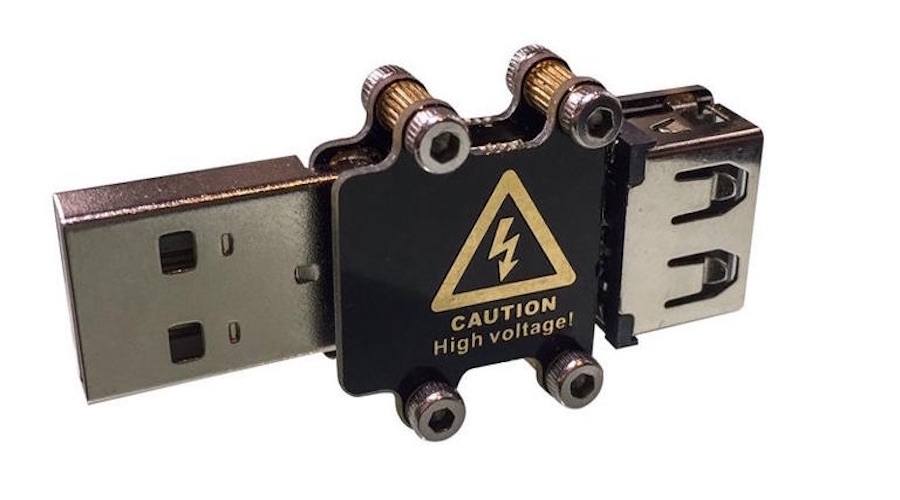
Killing pc's without virus awesome

USB Tester

The USB Killer stick that made headlines last year for being a brutal death to your innocent hardware is now up for sale in its upgraded USB Killer V2.0. The killer USB, priced at $49.95, can electrocute your device with 240 volts until it dies.

We have come across USB drives that have malware hidden inside. The malware makes your device its home as soon as the USB drive is connected to your computer. The health of your computer starts degrading and it moves towards a slow death.

There are another kind of ruthless USB Killer drives which can kill your computer or any hardware device with a USB port almost instantly and that too painfully. Last year, we heard about a USB killer . Now, the USB Killer V2.0 has become powerful than ever and is available on usbkill.com at a cost of $49.95.

The USB Kill V2.0 can permanently damage any device with a USB port, e.g., a computer, laptop, DVR, television, etc. An important point to consider is that the USB Kill is not made to serve any evil intention. Instead, it’s a power surge test device that can be used by hardware developers to observe the effects of such a disastrous thing on their hardware.
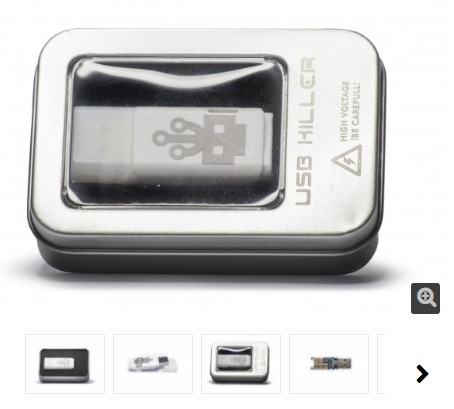
USB Kill

When the USB Kill stick is connected to the USB port of a device, it charges itself using the 5V power line until the voltage value reaches 240V. It then discharges itself into the data lines of the USB port causing a power surge leading to malfunctioning of the device. The charge and discharge cycle repeats until the USB Kill is removed from the device.

Almost 95 percent of the devices couldn’t stand in front the USB Killer V2.0 during the tests, says the company. However, the latest MacBooks were the only devices which weren’t affected by the USB Killer v2.0 stick.

If you want to test your hardware but don’t want to burn your device, the company has made a USB Killer Tester which protects your hardware when the USB Kill stick is used to test its surge protection capabilities. The Tester Shield also doubles up as a data protection tech. It prevents juice jacking data thefts when your device is connected to a USB port. The is available at $13.95.

If you have something to add, tell us in the comments below.
And don't forget to subscribe

Comments

Popular posts from this blog

get dolby atmos free on your PC

Welcome to my blog today i am here with very important item for your DDOOLLBBYY Atmos Everyone  or (at least geeks) knows  about the power of Dolby atmos we used to know that dolby atmos was only available for select PC only well not anymore from this link you can get in any pc note:  after installing dolby atmos install dolby access from https://dw27.malavida.com/dwn/8bdf73315506600b39e53dedb7616c896cc3811b629894bbe0bc994820b8af75/DolbyAccess.appx    and son't update from window store ..    just don't update it links http://gestyy.com/w2mDPI for dolby atmos   http://gestyy.com/w2mDKi  for device  driver ' http://gestyy.com/w2mDCF   for dolby atmos for gaming http://gestyy.com/w2mDN7    for dolby gaming driver if you  have any question feel free to comment

Lunix malware havoc

The Krebs DDoS attacks have proven that the IoT landscape is a fertile ground that can breed huge botnets capable of launching massive DDoS assaults. As such, it should be no surprise that malware authors are now focusing their efforts on this sector and putting out new threats in the hopes of building the next Mirai botnet. One of the latest additions to the IoT malware market is a trojan codenamed Linux/NyaDrop, recently reverse engineered by MalwareMustDie, the same researcher who discovered the Mirai malware. MalwareMustDie points out in his research that this binary appeared in May, but was somewhat simplistic and not that common. Things changed after the Krebs DDoS attacks, and a new sample has appeared on the market, with the malware’s author most likely drawn back to the IoT landscape by Mirai’s success. Just like most IoT malware nowadays, NyaDrop’s author relies on brute-forcing Internet-exposed IoT devices using their default credentials. In a conversati...

Remove virus from android

Desktops aren’t the only gadgets that can be affected by a virus. Android devices have a malware problem and it’s growing every day. If you do get a virus, you could perform a factory reset to get rid of it, but that means you’d lose all your data — those photos you shot, the saved games, the text messages, and everything else. Obviously, you want a factory reset to be your last option. So what can you do to remove a virus from Android without a factory reset? Is It Really a Virus? If your phone isn’t functioning the way it should be, there’s a chance you have some malware on it. One wrong tap somewhere and a malicious file might have been downloaded on your phone, which is leeching battery life, Internet resources, or your personal data. But it could be something else. Suppose your Android refuses to boot or crashes every time it starts up. Or maybe you can’t seem to download apps from the Play Store. These are not necessarily caused...